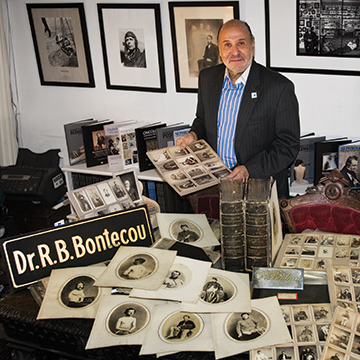
Showing posts with label Civil War Medical Photography. Show all posts

2/14/14

“Photography and the American Civil War” in New Orleans!


The extraordinary exhibition, “Photography and the American Civil War” opened at the New Orleans Museum of Art on January 30th. Dr. Burns and staff travelled to the opening, despite a snowstorm that cancelled flights and closed roads. 


Also able to escape a frigid New York for a freezing New Orleans was Jeff Rosenheim, Chief Curator of Photography at the Metropolitan Museum of Art and curator of the exhibition. Russell Lord, Curator of Photographs at NOMA graciously hosted two receptions, and, with Jeff, led a tour through the galleries. 
The exhibition showcases photographs of wounded Civil War soldiers from The Burns Collection, as well as hundreds of amazing images from the era. 
It was also a pleasure to see Sarah Simms former employee of The Burns Archive! She worked with Dr. Burns on the book, Shooting Soldiers, Civil War Medical Photography by R.B. Bontecou.
If you missed it in New York and Charleston, see it in New Orleans until May 4, 2014! 

http://noma.org/exhibitions/detail/77/Photography-and-the-American-Civil-War


Russel Lord, Stanley B. Burns, MD & Jeff Rosenhei

8/15/13

Last chance to see "Photography and the American Civil War" at the MET!

Photographs from our Reed B. Bontecou M.D. collection at the Metropolitan Museum of Art through September 2, 2013


For those who have procrastinated all summer long, now is your last chance to visit the MET and walk through this extraordinary exhibit. From the MET’s website:

More than two hundred of the finest and most poignant photographs of the American Civil War have been brought together for this landmark exhibition. Through examples drawn from the Metropolitan's celebrated holdings of this material, complemented by important loans from public and private collections, the exhibition examines the evolving role of the camera during the nation's bloodiest war.”


Throughout the summer, a number of publications as well as news outlets have covered the immensity of this exhibit, and the amazing job Chief Photography Curator, Jeff Rosenheim, has done. As part of their ongoing Study Day series, Stanley B. Burns M.D. was part of a distinguished panel of lecturers for a day-long event, “Study Day: The American Civil War and the Body.” A personal tour led by Jeff provided ticket holders with fascinating details about the photographs in the exhibit.


Visit the exhibit before it’s gone and see an entire space dedicated to images from The Burns Archive. The exhibit ends September 2, 2013.


1000 Fifth Ave. (at 82nd)
New York, NY 10028

ph: 212-535-7710

7/8/13

Dr. Bontecou's Photographs from the Burns Archive on CBS Sunday Morning


Photography that Changed the Way We View War: An overview of the Exhibit


Jeff Rosenheim, the Metropolitan Museum of Art's curator of "Photography and the Civil War," discusses images and details that provide a more intimate look at those who shaped our nation’s history and the photographers that travelled among them, documenting every step of the way. 


Although the segment aired Sunday, it is viewable online (notice our Bontecou photographs in the opening of the interview!). For those who can’t make it to the Metropolitan Museum of Art before September 2nd, the exhibit will be headed to Charleston and New Orleans in the coming months.  


1000 Fifth Avenue (at 82nd Street)
New York, NY 10028
Phone: 212-535-7710

5/29/13

Dr. Stanley B. Burns Speaks at Gallery Seminar at the Metropolitan Museum of Art

Study Day– The American Civil War and the Body

Friday, May 31, 2013 10:30 A.M. – 4:30 P.M.


Dr. Burns is part of a panel of distinguished guests speaking at an all-day seminar that engages in critical discourse about works of art in the galleries, as well as discussions and short lectures about the trauma of war through differing perspectives, ranging from historical to medical.


4/3/13

Photography and the American Civil War at the Metropolitan Museum of Art


Dr. Burns’ collection of medical photographs are showcased in a dedicated room as part of the MET’s exhibit. 
April 2 to September 2, 2013


The photographs of wounded soldiers and operative scenes taken by Civil War surgeon Reed Brockway Bontecou, MD are presented for the first time in a major art museum. 

Taken originally to show the effects of wounds, complications and the result of treatments the images are now recognized as among the highest level of portraiture. While it’s easy to photograph a beautiful subject, Bontecou photographed suffering and disability with a universal appeal as a result of his artistic posing and interpretation of war wounds. Jeff Rosenheim, Chief Curator of Photography of the MET and curator of this exhibit, has long recognized the artistic power of these portraits. 

The photographs show not the bravado of men about to enter battle, an all too familiar topic of interest for collectors and curators, but the true personal results of war for service personnel and their families. These images portray men, young and old, starring at us stoically, carrying their wounds. They are presented as people, not specimens, as a result of Bontecou’s art in posing. The images are significant additions to the visual culture of war and American medicine.The photographs are eloquent works of art that offer unflinching testimony to the suffering caused by America’s bloodiest war in which over 750,000 died and hundreds of thousands were wounded.

The exhibit is about documenting the war as well as the evolution of the medium of photography itself. Bontecou’s images presented near the end of the exhibit are representative of this evolution.

The slideshow provides a brief glimpse of the patrons party, the exhibition room with Dr. Bontecou’s photographs and the opening night reception.


Dr. Burns text- Shooting Soldiers: Civil War Medical Photographs by R. B. Bontecou is available form the Burns Press.


11/28/11

The New York Review of Books: Someone Else's Children

The Burns Archive is pleased to announce our exhibition Reed Bontecou: Masterpieces of Civil War Portraiture and accompanying publication Shooting Soldiers have been covered by The New York Review of Books:


Someone Else’s Children

Christopher Benfey
November 28, 2011

My wife and I have two sons, aged eighteen and twenty-two. Both have registered for the Selective Service, as the law requires. (“Our objective is to register you,” the official letter reminded them, “not to have you prosecuted.”) We don’t have a clear idea of Tommy’s or Nicholas’s views regarding military service; we hope that circumstances won’t force us to find out. None of us knows any men or women currently serving in Iraq or Afghanistan. They are someone else’s children. We watch news reports of wounded veterans learning to walk with prosthetic limbs. Recent stories about body parts mislaid at the military mortuary at Dover Air Force Base fill us with outrage. Still, for many of us, it is a general, not an individualized outrage.


During the Civil War, in contrast, the mangling of young bodies was evident to all. Three million volunteers armed with advanced rifles, and firing at one another at point-blank range, fought on battlefields often not far from their own homes. American writers, many of whom had children in the war, were not insulated from the carnage. Fred Stowe was standing in the graveyard on Cemetery Ridge, above Gettysburg, when a live shell exploded near his ear, opening a wound that never healed. Charles Longfellow sought distraction from the trauma of the war in Yokohama, where he had a giant carp tattooed across his back, around the scars of two bullet holes. Emily Dickinson chose as her literary advisor a Union colonel suffering from PTSD: “We can find no scar,” she wrote in a famous poem, “But internal difference— / Where the Meanings, are.”


Louisa May Alcott and Walt Whitman served as nurses and eyewitness reporters in the hideous Union hospitals in Washington, D. C. Alcott contracted typhoid in the septic wards and wrote Little Women, about the daughters of a father wounded in the war, while treating herself with mercury. Whitman ministered to the needs of wounded soldiers while also keeping a careful visual record of everything he saw, “this other freight of helpless worn and wounded youth,” as he wrote to Emerson. “Doctors sawed arms & legs off from morning till night,” he reported in his journal. He was dismayed to see “a heap of feet, arms, legs, etc., under a tree in front of a hospital.” As he moved from bed to bed in the overcrowded wards, he was shocked by the youth of the victims. “Charles Miller, bed 19, company D, 53rd Pennsylvania, is only sixteen years of age, very bright, courageous boy, left leg amputated below the knee.”


The remarkable medical photographs of the Civil War surgeon-photographer Reed Bontecou—now published in their entirety for the first time and recently shown at The Robert Anderson gallery in New York—bring us closer still. Bontecou, from Troy, New York, was a classifier of seashells and an ornithologist who had traveled in the Amazon before the war collecting specimens. A pioneer in surgical procedures known for the dexterity and speed of his operations, he was also a photographer of genius. His iconic image, “A Morning’s Work,” shows a pile of amputated legs he himself had sawed off earlier that day. Bontecou’s albums served many ends, most obviously instruction, with before-and-after shots, in the identification and treatment of conditions like gangrene and bullets lodged in bone. But they also aided in the later identification of veterans for disbursement of disability and pension funds. Bontecou was apparently an engaging and capable administrator of army hospitals who was once threatened with disciplinary action for inviting a recovering Confederate officer to his home for Thanksgiving dinner.


Most poignant and painful is Bontecou’s artistic ability to capture the terror of his patients, what the editor and collector of medical photographs Stanley Burns, M.D., calls “individual bereavement.” Pvt. John Parmenter, unbearably young, lies prone on an army cot with his beautiful and vulnerable face turned towards us and his gangrenous foot propped up on a cushion. Then, in another photograph, we see him lying deathly pale and unconscious; a surgeon with his hand on one of Parmenter’s bent knees looks down thoughtfully at the severed foot. The picture has some of the bleak, geometrical power of Jacques-Louis David’s Death of Marat.

In another arresting image, Robert Fryer, eighteen years old and wearing his cap and uniform, all gold buttons carefully buttoned, holds his hand to his chest as though playfully mimicking a handgun. His features are deadpan. At first, we assume his hand is partially hidden in his jacket. But no, it’s an illusion, presumably deliberate on the part of the photographer. Fryer’s middle, ring, and little fingers are amputated. According to Bontecou’s notes, “Patient has good use of forefinger and thumb.” Perhaps he watched young Robert Fryer buttoning his coat.

The photographs are a bitter reminder of the hideous race between better medical response and ever more devastating weaponry. If, as Burns notes, the improvised explosive device (IED) has changed the way war is fought and the wounded treated today, the novelty of the Crimean War and the Civil War was the 58 caliber Minie Ball, named for its inventor, Claude-Etienne Minié. This was a war in which 94% of Union wounds were caused by bullets. The Minie Ball, Burns remarks, “shattered and fractured bone easily and commonly carried clothing and other debris with it into the wound, making infection a constant companion in almost every case.” Bontecou’s images “documented the battle against gunshot wounds,” at a time when battle armor was minimal or absent and two years before the discovery of the principles of antiseptic surgery in 1867. Burns adds grimly, “Many of the men we see here are going to die.”

There is another race on display in these photographs, between the sheer horror of the army hospital and our ability to find words and images adequate to the horror. “The real war,” Whitman wrote in Specimen Days, “will never get in the books.” The simple identification boards that many of Bontecou’s patients hold in their hands, with their name and company inscribed in white chalk, carry their own dire and individualized lyricism, as though to say, in Whitman’s resonant words: “I am the man, I suffered, I was there.” Andsell H. Beam, shot in the skull on April 6th, 1865, bows over his identification board as though in prayer, or in simple disbelief in his unfathomable fate. “Now that I have lived for 8 or 9 days amid such scenes as the camps furnish,” Whitman wrote his mother, “… really nothing we call trouble seems worth talking about.”

Shooting Soldiers: Civil War Medical Photography By R.B. Bontecou by Dr. Stanley M. Burns has recently been published.


11/21/11

Civil War Book Review: Shooting Soldiers

Looking Wounded Soldiers in the Eye

Shooting Soldiers: Civil War Medical Photography by R. B. Bontecou showcases the Civil War photography of Dr. Reed Brockway Bontecou, Surgeon-in-Charge of Harewood General Hospital in Washington, D.C. This book is the first in a series of Bontecou’s photographs of identified soldiers from 101 regiments from the Harewood Hospital Album.


While the photographs may be graphic to some readers, it documents the high cost that soldiers paid for what they believed in a country of united states. Bontecou’s photographs, or carte de visites (CDV) were a result of the order by Surgeon General William A. Hammond to document the cases that the surgeons worked on, their treatment, and their outcomes. Many of Bontecou’s photographs helped illustrated the post-war publication of The Medical and Surgical History of the War of the Rebellion.


The artistry of Bontecou’s pictures has been recognized as among the highest levels of photographic art and helped make him a legend among medical photographers. “Due to their historical precedence there can be no doubt that Bontecou’s carte de visite album is the premier medical photograph album of the Civil War” (8). Included among the images are close-ups of patients in the OR and of surgeries in progress the earliest known of such views.


This volume also contains a sketch of Bontecou’s career, a history of the various images, and a brief summary of the last campaigns of the war. Each of the images identifies the soldier, what unit he belonged to, his wound, where received and date, treatment, and outcome. Some of the images have more information than others. The last few pages of the book list the battles, from the Wilderness to Appomattox, the soldiers in this book, their unit and plate number. Also included in this section are those with no battle listed and those who died of disease (not in battle). This book represents the earliest efforts of one physician to document war-related wounds and, by the use of photography, present to fellow physicians a way of caring for those wounds.


Shooting Soldiers is a well-written, fast and easy-to- read book. Each image gives the reader a look into the tragic costs of the most turbulent time in America’s history.


The author of this book, Dr. Stanley B. Burns, M.D., an internationally known historian, publisher, and archivist, is an ophthalmologist in New York City and Clinical Professor of Medicine and Psychiatry at NYU Langone Medical Center.

Peter J. D’Onofrio, Ph.D. is the president of the Society of Civil War Soldiers, Inc., the largest non-profit, tax-exempt, international educational group dedicated to the study and preservation of Civil War era medical and surgical techniques and the professionals who performed those techniques. He is also the editor/publisher of the Society’s quarterly Journal of Civil War Medicine. He can be reached at socwsurgeons@aol.com or through the web site at www.civilwarsurgeons.org.

To Learn more about Civil War Book Review, Louisiana State University Libraries' Special Collections please visit www.cwbr.com

To Purchase Shooting Soldiers, visit our online book store http://burnspress.com/

10/27/11

Burns Archive Exhibition Reviewed in The New Yorker

Goings On About Town: Art

Reed Bontecou

Bontecou, the head surgeon at a Washington, D.C., Army hospital during the Civil War, photographed wounded soldiers to document their injuries and treatment. His sepia-toned albumen prints were mounted in the elegant oval formats typical of the period’s popular carte-de-visite portraits, and his subjects do their best to strike a formal pose while half dressed and badly hurt. In the nearly fifty small examples here, grave young men display amputated limbs, bullet wounds, missing fingers, and disfigured faces. But Bontecou’s sympathy turns what could be mere medical curiosities into true portraits—complicated, touching, and unsettling. Through Nov. 12.

Through November 12
24 W. 57th St., New York, NY
646-455-0393

9/29/11

Reed Bontecou: Masterpieces of Civil War Portraiture at The Robert Anderson Gallery


     The Burns Archive is pleased to announce the opening of the first major commercial exhibition of Reed B. Bontecou, MD’s Civil War photography. Bontecou’s photographs challenge the master photographers of his era.
 
Sepember 28 - Nov 12, 2011  
Reception Oct 6, 6-8pm

Robert Anderson Gallery24 West 57th Street, Suite 503
New York, NY, 10019
Hours: 11am -6pm, Tues - Saturday


Robert Anderson Gallery Press Release:
The 43 albumen photographs on view at Robert Anderson Gallery compromise a rare, and for the most part, first time ever public view of the unique medical images by Reed Brockway Bontecou, MD, Surgeon in-Charge of Harewood U.S. Army General Hospital, Washington, D.C., from the Collection of Stanley B. Burns, MD.  In recognition of the sesquicentennial of the Civil War, Robert Anderson Gallery offers this rare collection of albumen portraits and cartes de visites of wounded soldiers, selected from Bontecou’s personal albums.  The photographs represent a unique opportunity to view some of the most moving documents of the Civil War and the associated human casualties. 

Reed Bontecou was responsible for pioneering, and taking, the largest number of photographs of wounded soldiers during the Civil War and was the single largest contributor of photographs and specimens to the Army Medical Museum and medical publications of the time. His close up images of surgery, anesthesia, and patients posing with their pathological specimens were unique to his time. Many photographs are of patients pre- and post- operation, views of patients showing the progression of specific treatments, or the various stages of diseases. After the war he organized his photographs into albums laying them out, anatomically from head to foot wounds, and loosely alphabetically by soldier’s name.

Bontecou’s images are beautifully posed, and the sitters seem almost serene in his gaze, elevating clinical photography to an art form. They speak a universal language of war, or rather, what it can do in human terms. Bontecou was a master of exposing the nature of the sitter. Beyond the wounds, the amputations, and the gangrene, the subject is presented as naturally as possible. It should be noted that smiling in photographs during this early period was very rare and the subject put on his best expression. Some images are further enhanced by Bontecou’s own red pen, detailing the trajectory of the bullet that impacted on the patient. These images, with the hand drawn lines, were part of his personal Harewood Hospital teaching album.

Also on view are his Cartes de Visites, an amazing visual document of the medical aspects of war and examples not equaled until fifty years later during WW1. The CDV album is the pioneering effort by one physician to document war wounds and to use photography to teach physicians how to care for these wounds. Due to their historical precedence there can be no doubt that Bontecou’s CDV album, kept at Harewood U. S. A. General hospital, is the premier medical photograph album of the Civil War.  No other large compilations of war-time clinical images exist, with over 570 images. On view will be one page of the album, comprised of 12 single CDVs, and four single CDVs from The Amy Medical Museum, Photographs Contributed by R. B. Bontecou.

7/18/11

The Wall Street Journal Reviews Burns Archive Exhibit:

Dr. R.B. Bontecou's photo of Pvt. Robert Fryer

Shadows and Light Somewhere in Time
Wall Street Journal, July 16, 2011
by William Meyers
Their faces are as telling as the wounds they suffered. Unlike Mathew Brady, who was a commercial photographer, Reed B. Bontecou was an army doctor: He took photographs of wounded Civil War soldiers in the first systematic attempt to study combat injuries and the procedures used to treat them. 
"Robert Fryer, private, Co. G, 52d N.Y. Vols., aged 18" stares at us from an oval frame. His kepi is on his head, and against his uniform jacket with its long row of brass buttons he holds his right hand: Only his thumb and forefinger are left. His look expresses neither pain nor self-pity, but his troubled attempt to understand his experience. 
There are two pictures of "David R. Templeton, Private Company A, 46 N.Y Vols., age 16, …. with gunshot wound of the head." 
The first must have been taken soon after he lost his eye, since the left side of his face is covered with blood and he seems to be suffering.
In the second photo, he has been cleaned up and dressed, his hair combed, but his one open eye expresses the same dazed puzzlement as Pvt. Fryer. 
Other soldiers have other parts of their bodies violated or missing. Dr. Bontecou's brief descriptions of where and how each patient was injured, the treatment he received and the outcome—"parts healed kindly," "gradually sank and died"—are posted in notebooks attached to the display cases. 
Excerpts from Walt Whitman's "Specimen Days" describing his experiences working as a nurse in Union military hospitals provide context. The photographs come from the extraordinary collection of Stanley Burns, a New York physician.

Civil War Exhibit Extended Until August 29


NEW YORK'S CIVIL WAR SOLDIERS
Photographs of Dr. R. B. Bontecou, Words of Walt Whitman. 
EXTENDED THROUGH AUGUST 29, 2011
Merchant's House Museum, 29 East Fourth Street, NY, NY

From Broadway World.com
Thanks to an overwhelming response from visitors, the Merchant's House Museum, in partnership with The Burns Archive, will extend the exhibition of photographs of wounded New York soldiers by army surgeon and native New Yorker Dr. Reed B. Bontecou that opened in April to commemorate the 150th anniversary of the start of the Civil War. More-than 100 images of human ruination are captioned with quotations from Walt Whitman's 1882 memoir, Specimen Days, in which he recounts his own horrifying experience as a volunteer nurse. According to Whitman, "The real war will never get in the books."
William Stewart, 3 NY Independent Battery.
 Aged 20 years, wounded at Petersburg, March 25, 1865.
Gun shot wound of humerus, resection of head of right humerus
A View of One of the Displays of Bontecou's Photographs
on Exhibit at the Merchant's House Museum.

5/25/11

New York Times: The Local East Village Covers Burns Archive Civil War Exhibit

Selections from The Burns Archives. Montage by Tim Milk. All photos courtesy The Burns Archive.
We are pleased to announce that our exhibition at The Merchant's House Museum was featured by The New York Times Local by Tim Milk. To read the article The Pain of War at The Merchants House click HERE.

If you still haven't made it to The Merchant's House to see the exhibit there is still time!


New York's Civil War Soldiers – 
Photographs of Dr. R. B. Bontecou, Words of Walt Whitman.
Through Monday, August 1
Merchant's House Museum
29 East Fourth Street, New York, NY 10003
Open 12 to 5 p.m., Monday, Thursday, Friday, Saturday & Sunday


To purchase our new photography book Shooting Soldiers: Civil War Medical Photography by R. B. Bontecou visit www.burnspress.com.

4/18/11

WNYC NEWS: THE BURNS ARCHIVE CIVIL WAR EXHIBITION


Merchant's House to Display Photos of New York Civil War Regiment Soldiers


Wednesday, April 13, 2011


On April 13, 1861, the U.S. Army garrison at Fort Sumter, South Carolina surrendered to Confederate troops. Two days later, President Abraham Lincoln issued a proclamation calling for 75,000 militiamen to pick up their rifles and squelch the southern rebellion. The American Civil War was on.  
In honor of the soldiers who put their lives on the line in the ensuing four years of war, the Merchant's House Museum in Manhattan is presenting a series of photographs of wounded Civil War soldiers who served in New York regiments. The exhibit marks the first time any of the photographs will be displayed to the public in the 150 years since the war.  
Military historian and Civil War reenactor Robert Mulligan, who is from Albany, said the New York battalions included some notable troops.  
"One was in the box with Lincoln when Lincoln was shot, and another was the first union officer killed in the war, Elmer Ellsworth," he said.  
Each photograph at the Merchant's House Museum exhibit was taken by Reed Brockway Bontecou, who was the surgeon in charge of Washington, D.C.'s Harewood U.S. Army General Hospital. When the war ended, the photographs became the largest part of the government’s war medical photograph collection.  
Mulligan has for years played the roles of Corporal James Tamer of the 86th New York Infantry and Sargent Rice C. Bull of the 103rd New York Infantry. Bull was injured in battle and Tamer lost both of his feet, but Mulligan doubted that either of the men passed through Bontecou's hospital.  
"It was a hub of medical treatment, but I'd be surprised to find their photographs," he said. "There were just too many injured soldiers."  
In 1975, a New York City ophthalmologist who had taken an interest to collecting historical photographs, Stanley B. Burns, acquired the photographs from the Bontecou family. He soon established the distinguished Burns Collection, which has since become the nation’s largest private comprehensive collection of early medical photography.  
Dr. Burns has published two (of three) volumes of the Bontecou photographs. The most recent one, "Shooting Soldiers: The Civil War Medical Photography of Reed Bontecou," will be released on Thursday to coincide with the opening of the Merchant's House exhibition.   
At the exhibit, more then 100 graphic photographs of human disfigurement will be accompanied by passages from Walt Whitman's "Specimen Days,"  a memoir of his horrific experiences as a volunteer nurse. Along with other images and memorabilia of the time, the words tell the real story of the Civil War that Whitman said would "never get into the books."


To see the article on the WNYC website and view the slide show click HERE